Why synthetic stucco needs breathable EIFS coatings, not house paint
Standard exterior latex house paint is formulated for wood siding and trim, not foam-backed lamina. Rolled onto EIFS, stiff retail paint skins over tiny thermal movement cracks until the film splits, or it slows outward water-vapor diffusion enough that moisture blisters the finish from behind. Proper EIFS refurbishment relies on coatings built for synthetic stucco: vapor-permeable pure acrylic architectural coatings where color renewal and dirt shedding are the main goals, or breathable elastomeric EIFS coatings where fine hairline crazing needs flexible crack-bridging build.
Before recommending any coating system, we verify that the wall actually qualifies for recoating. Coating renews a dry, structurally sound facade; it never glues loose lamina back onto soft sheathing. During our walkthrough we check suspect window corners, roof intersections and grade lines so any needed EIFS repair is completed before a roller or sprayer touches the wall.
Surface prep, crack bridging and joint sealant renewal
Lasting adhesion on weathered acrylic texture comes from careful wash and joint prep rather than brute water pressure. High-pressure tips slice straight through thin EIFS finish and scar the foam core. Our crew removes chalk, road film, mildew and dark north-wall algae streaks using EIFS-safe cleaners and controlled low-pressure rinsing, followed by full dry time.
Once the elevation is clean, we address the details that make a recoated building look freshly finished rather than painted over:
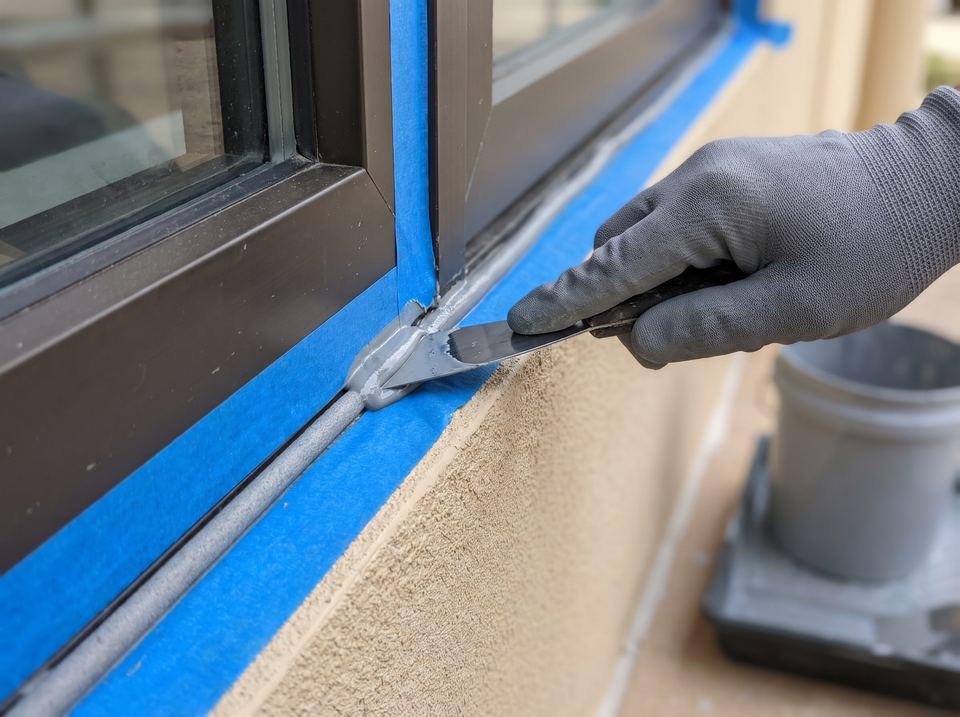
- Sealant replacement: Sun-baked, split caulk around windows, expansion joints and louvers will telegraph right through fresh topcoat. We cut out failed beads, install closed-cell backer rod and tool low-modulus waterproofing sealant compatible with the coating system.
- Mesh and base-coat skimming: Where old tenant signs came down, corners were chipped, or surface crazing runs too wide for coating alone, we embed fiberglass mesh in base coat and float matching texture so repairs disappear under the new color.
- Masking and safe access: Windows, brick, anodized frames, roofs and landscaping are masked tight and reached from boom lifts or our own scaffolding.
Updating faded Saratoga plazas, HOA facades and residential elevations
Across Clifton Park, Malta, Saratoga Springs and Queensbury, twenty-year-old tan, rose and beige EIFS walls often look worn strictly from UV chalking and roof-edge runoff stains. Recoating lets shopping-center landlords modernize strip-plaza colors for incoming tenants, helps condo and HOA boards bring multi-building communities back to a uniform standard, and lets homeowners unify an elevation after moisture patches.
Our crew handles architectural finishes on public and commercial sites as well as private homes. In 2026 we completed the EIFS canopy refinish at Casey Stadium at the University at Albany under a public contract, along with the EIFS feature panel finish at the Shake Shack in Clifton Park. For shopping centers, medical buildings and hotels, see our commercial EIFS page.
Recoating budgets and cure-weather windows
Recoating costs far less than stripping and re-cladding a facade because sound insulation, mesh and trims stay in place. Pricing follows total wall area, lift or scaffold access, linear footage of perimeter sealant replacement, and whether dramatic color changes call for tinted primer plus two finish passes. Primers and coatings require wall and air temperatures of about 40 °F and rising with no freezing for 24 hours, making spring through late fall our application window across the 518.