EIFS repair · Whole 518
EIFS repair across Saratoga, Warren, Rensselaer and Schenectady counties
Cracked corners, woodpecker holes, dark tear stains and spongy sections on foam-insulated walls can usually be repaired in sections once the leak behind them is corrected.
Call or text (518) 888-7851
Book spring work now. Winter assessments and estimates available.
Updated November 2026
Short answer
Most EIFS damage across the 518 can be fixed in sections without stripping the whole facade. Our crew removes wet or punctured foam, checks the sheathing, corrects missing flashing or failed sealant, rebuilds the foam, mesh and base coat, and matches the finish. Finish coats need about 40 °F and rising. Text photos for a free estimate.
Key facts
- Service area
- Saratoga Springs, Clifton Park, Malta, Glens Falls, Queensbury, Lake George, Troy, Schenectady and the rest of the 518.
- Season
- EIFS and stucco finishes need about 40 °F and rising, with no freezing for 24 hours. In the Capital Region that means spring through late fall.
- Who does the work
- Our own crews, from The Dom Construction Group LLC.
- Insurance
- General liability, umbrella and workers' compensation insurance; certificates on request.
- Estimates
- Free. Start with 3–5 photos by text, or use the form.
- Reply
- We reply within one business day, Monday to Friday.
Failures we repair on Dryvit- and Sto-style foam walls
Exterior insulation and finish systems pair expanded polystyrene foam board with a fiberglass-mesh base coat and a textured acrylic finish. When detailed well, the lamina flexes through seasonal temperature swings and keeps heat inside. When water gets past a joint or flashing gap and freezes, damage spreads out of sight behind the surface. Across the 518 we fix:
- diagonal stress cracks radiating from window and door corners or along unjointed floor lines
- woodpecker holes on wooded lots around Queensbury, Lake George, Ballston Spa and Saratoga Springs, which let rain and insects straight into the foam core
- spongy, hollow-flexing or bulging areas below roof valleys, dormers, balconies and deck ledgers
- split, hardened or pulled-away caulk around window frames, light blocks, vents and meter boxes
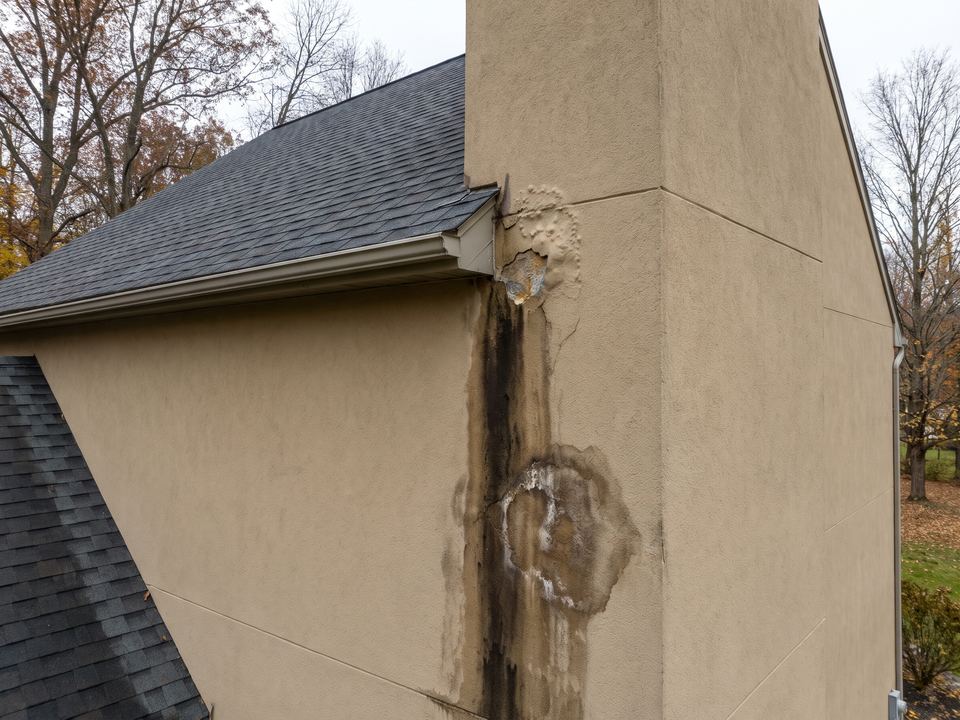
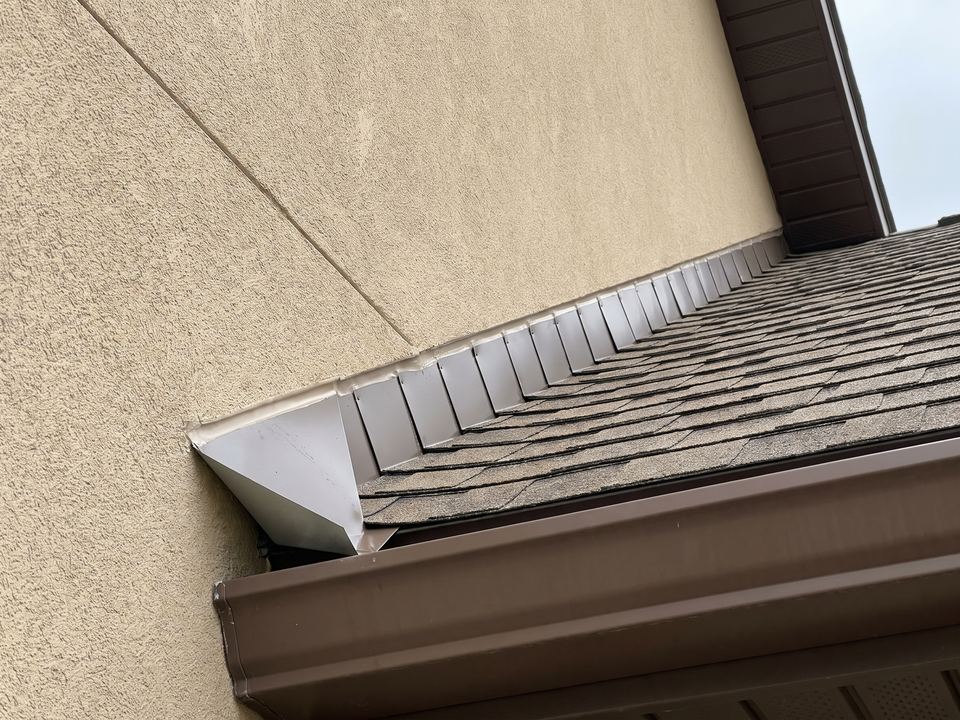
- missing kick-out flashing where sloped shingle roofs die into taller EIFS sidewalls, plus missing metal drip caps over projecting trim bands
- foam board carried down into mulch beds, asphalt walkways or porch roofs where winter snowbanks sit and wick water upward
On a home in Schenectady in 2026, for instance, a cracked decorative EIFS band kept leaking until we rebuilt the damaged section and installed a new drip cap above the projection so runoff shed clear of the wall face.
Probing behind cracks before quoting a repair scope
A hairline craze in the acrylic finish needs a very different fix than soft OSB or gypsum sheathing behind a stained window corner. When we look at a building in Clifton Park, Troy or Glens Falls, we trace the rooflines, gutters, grades and window joints above the trouble spot first. Where hidden moisture is likely, we check below window miter joints, roof-to-wall step flashing and band transitions—only opening a wall with the owner's permission—before locking in the repair boundary.
You see clear photos of what is dry and sound versus what has to come off. On dry foam, we clean and detail the crack, embed alkali-resistant reinforcing mesh in polymer base coat, prime, and float new acrylic texture. Where water has softened the substrate, we strip the wet foam, replace rotted sheathing, tie in fresh water-resistive barrier and flashing, bond new insulation board, back-wrap clean terminations, and rebuild the reinforced lamina.
Choosing between spot blending, elevation recoating and re-cladding
On newer or shaded elevations where the surrounding finish still holds its color, we match the aggregate size and float pattern and break the patch cleanly at control joints, inside corners or trim bands. After fifteen or twenty summers of Saratoga or Northway sun, fresh pigment beside chalked acrylic can leave a visible clean patch. In those cases we price the repair alongside full-elevation EIFS recoating from corner to corner so the wall looks uniform.
Where probing reveals widespread sheathing decay across an old barrier-type wall, piecemeal patching stops making financial sense. We put the repair price side by side with stripping that elevation and installing new drainage EIFS. Owners and condo boards who want wall conditions mapped first for budgeting can book one of our EIFS and exterior inspections.
Typical EIFS repair pricing and temperature limits
Localized crack, woodpecker-hole and minor impact repairs usually run from a few hundred to a couple of thousand dollars, depending on wall height and blending boundaries. Moisture cutouts involving sheathing replacement, new flashing and scaffold setup cost more according to how much wall opens up. Base coats, primers and finishes need about 40 °F and rising with no freezing for 24 hours, so finish work runs from spring to late fall while estimates happen all year.
Missing kick-out flashing at roof-to-wall intersections
AI-generated illustration
AI-generated illustration
How an EIFS moisture repair goes back together
Every cutout follows the water path first so rebuilt lamina stays dry.
Cut back to dry, firm substrate
Wet foam and compromised OSB or gypsum sheathing are removed back to solid framing and documented with photos.
Restore barrier and metal flashing
New sheathing is tied into the water-resistive barrier, and missing kick-out diverters or drip caps go in before foam.
Bond foam and embed reinforcing mesh
Fitted EPS board is adhered flush, edges are back-wrapped, and fiberglass mesh is embedded into polymer base coat.
Prime, float texture and seal joints
Tinted primer and aggregate-matched acrylic finish blend to clean break lines, finished with closed-cell backer rod and sealant.
Questions on EIFS patching and moisture repair
Can woodpecker holes in EIFS be patched without replacing the entire wall?
Yes, when caught before rainwater saturates the sheathing behind the hole. Woodpeckers drum on hollow-sounding foam bands near wooded lots around Lake George, Queensbury and Saratoga Springs, punching straight through the mesh and base coat. Repairing them involves cutting back to clean, dry foam, plugging the void with fitted EPS insulation, embedding overlapping fiberglass reinforcing mesh in base coat, priming, and floating matching acrylic texture.
Will an EIFS patch blend in with a twenty-year-old weathered facade?
Texture aggregate size and float pattern can be matched closely, and stopping repairs at existing expansion joints or trim bands hides transitions well. On sun-exposed south and west walls where pigment has chalked for years, fresh acrylic finish can still look cleaner and slightly brighter than surrounding aged panels. Where color contrast would stand out, coating that full elevation from corner to corner creates one even shade.
What happens when snowbanks pile up against the bottom of an EIFS wall?
EIFS carried straight down to soil, asphalt driveways, patio pavers or porch roofs sits buried in wet snow and ice through long Capital Region winters. Melting snow wicks upward into unsealed bottom edges, freezing and popping the lamina loose along the base. Proper repair cuts the EIFS back above grade or roof flashing, installs a back-wrapped weeped starter track or drip termination, and leaves open clearance below.
Do you replace rotted wood or gypsum sheathing found behind wet EIFS?
Yes. Bonding new foam over soft OSB, plywood or deteriorated gypsum core board guarantees the repair will fail again. When wet sections are opened up, compromised sheathing is cut back to solid framing, replaced with sound exterior sheathing, covered with tied-in water-resistive barrier membrane and metal or flexible flashing at openings, and photographed for the owner's records before new foam board and mesh go back on.
How much does a typical residential or small commercial EIFS repair cost?
Localized crack repairs, equipment dings and woodpecker-hole patches commonly fall between a few hundred and a couple of thousand dollars depending on height above grade and finish blending boundaries. Moisture-intrusion rebuilds below roofs, decks or leaking windows vary more widely because final pricing follows how much wet sheathing must come off, what flashing details are missing, and whether scaffold or lift access is needed.
Request a free EIFS repair estimate
Attach or text a close-up of the damage and a wide shot showing the roofline and windows above it.
Related 518 EIFS services for damaged facades
- EIFS & exterior inspections
Paid wall assessments for repair planning; the fee credits toward your contract.
- EIFS recoating
Clean and recoat weathered elevations so repaired walls read one even color.
- Waterproofing & sealants
Window perimeter caulking, drip flashings and breathable wall coatings.
- New drainage EIFS
Full-elevation replacement when an older barrier wall has failed broadly.
Spot a soft corner or cracked band? Send us a photo.
Book spring work now. Winter assessments and estimates available.